
How Social Should A Newscast Be?
While many stations are still tinkering with ways to use Facebook and Twitter, KOMU Columbia, Mo. (DMA 138), is making social media a star of one of its shows.
U_News@4, which debuted last week on the University of Missouri-owned NBC affiliate to fill its Oprah void at 4 p.m., pushes viewer participation to new heights. In fact, the show is so interactive that anchor Sarah Hill refers to participating viewers as her “co-hosts.”

The hour-long show includes news and weather, but that’s about as traditional as it gets. On the high-tech set, Hill commands the newscast from a laptop with a second large screen behind her for all to see.
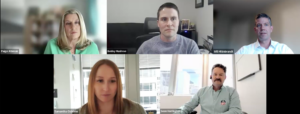
Thanks to tools like “hangouts,” multi-person video chats that are part of Google+, as well as other social media that already seem old hat — Tweets, email and texting — viewers are integral parts of the newscast, providing everything from viewpoints to videos, says Executive News Director Stacey Woelfel.
At any given moment, up to 10 individuals may "appear" on air with Hill through the various media, Woelfel says. Last night, Hill reported on Obama’s proposed tax plan, after which the people in her hangout chimed in on the issue.
Hill also checks in regularly with the “social media desk,” which includes two reporters tracking bloggers, Tweets and online conversations about topics making the news. On Monday, they reported on the decision to cast transgender Chaz Bono on Dancing With the Stars and a conservative group’s call to boycott the show.
Although KOMU had been exploring options for the 4 p.m. slot for some time, it settled on trying a fully interactive newscast in February after viewers helped cover a blizzard via social media, Woelfel says. “These are regular people. We were amazed how capable and willing viewers were to contribute."
Industry watchers applaud KOMU for pushing the envelope in its use of social media at a time when many stations are still trying to figure them out.
“Web culture is about experimenting and trying new things,” says Robert Hernandez, a USC Annenberg assistant professor who follows technology and journalism. “That’s what the new journalism is about."
Only time will tell, however, whether the experiment will ultimately work.
Just last month, WSLS, Media General’s NBC affiliate in Roanoke, Va., (DMA 66), replaced its two-year-old 7 p.m. newscast that relied heavily on social media with the more traditional one viewers said they wanted, says News Director Melissa Preas.
When the show was first launched, incorporating viewer input into newscasts via social media was still a novelty, and seemed to be a big enough deal to draw audiences, she says.
The novelty, however, soon wore off, as other stations around the country gradually started adding interactive components to their newscasts, Preas says. WSLS went back to basics, emphasizing content over fancy new tools and using social media to supplement conventional broadcast journalism.
“Even though I am delighted to see places trying all of these things, it doesn’t mean that they work,” says Bob Papper, a Hofstra University journalism professor. “You need to be very cautious. Most people don’t ‘friend’ TV stations.”
As few as 5% of TV viewers actually engage with TV news via social media, he says. “Part of the success of TV news is that it’s the ultimate passive medium,” Papper says. “If you’re going to respond to the activities in what is generally a passive situation, you need to recognize that you are taking some risks.”
Steve Safran, editor of LostRemote.com, which bills itself as “All About Social TV,” favors TV stations incorporating social media into conventional newscasts. TV stations that use them to supplement rather than supplant their newscasts are the most successful, he says. And although social media can enhance broadcast journalism, the two should not be treated as one and the same, he says. “I think it gets too artificial when you slap one on top of the other.”
Stations are employing social media in a variety of ways.
In Phoenix (DMA 13), Belo's independent KTVK last month launched a 10 p.m. newscast that also incorporates a lot of social media because, as Executive News Director Brad Remington says, "it’s how people consume news.”
In a market with five news-producing stations, the newscast is designed to stand out, Remington says. But that’s not at risk of being gimmicky. “Our view is that it needs to be authentic,” Remington says.
What that means is that the newscast incorporates features of social media that have been growing in use anyway — reporter and anchor Tweets and viewer-generated content and comment, for example.
Anchors broadcast the news standing up and are equipped to pull content from iPads while on air. The community engagement occurs long before — and after — the newscast.
“It’s an all-day-long conversation,” Remington says. “We don’t think we’re reinventing local news, but it’s fresh. If you want to be involved in the social media side while you’re watching it, we are providing some opportunities. But it’s still a good 10 p.m. newscast.”

Comments (2) - Post a comment